
Dark warehouses
1. EXECUTIVE SUMMARY
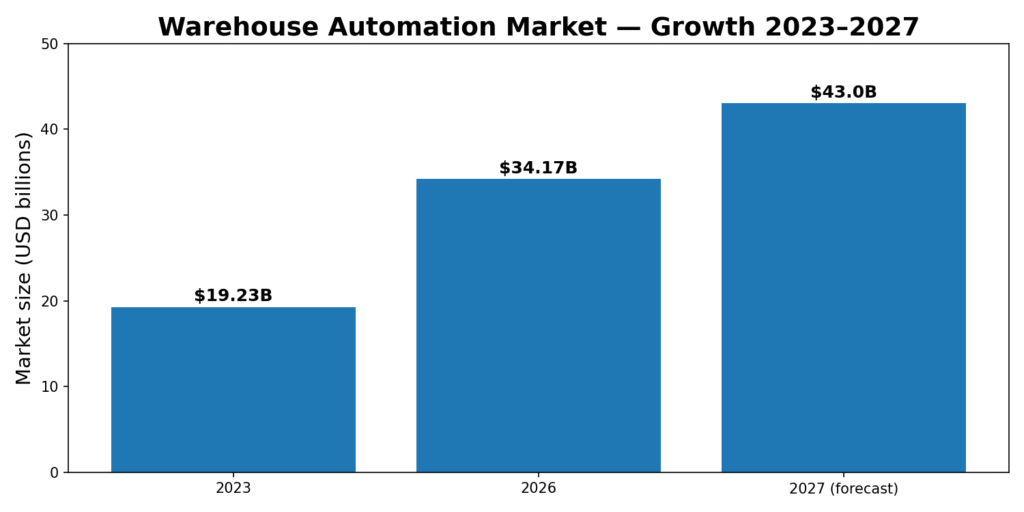
Dark warehouses are robotic facilities. No humans work inside. Machines do not need light, heat, or breaks. They run 24/7 at constant speed. Their accuracy is beyond what humans can sustain. The warehouse automation market hit $34.17 billion in 2026. Three years earlier it stood at $19.23 billion. By 2027, 26% of all warehouses will have some form of automation.
But reality is more complex. Removing all humans from the process is still a challenge. These systems require a careful balance between upfront cost and long-term return
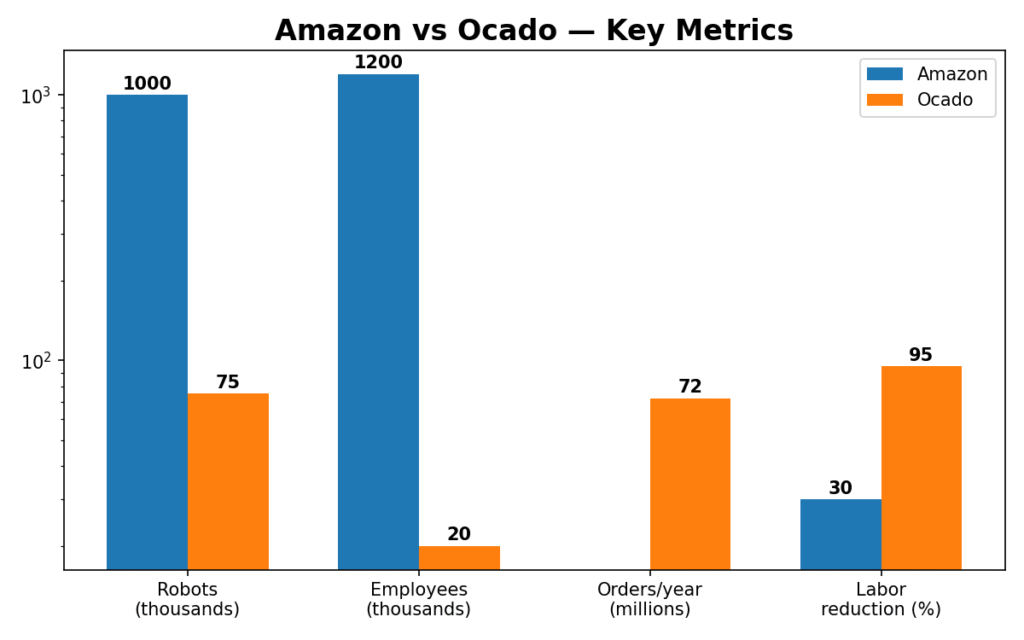
Amazon has over 1 million robots in its network. It still employs 1.2 million people in its warehouses. Robots do well on repetitive tasks. They struggle when something breaks or a judgment call is needed. Humans fill those gaps.
Ocado processes 72 million orders per year with its robotic centers. Yet the company faces serious financial trouble. These systems cost a great deal to build. It takes years before they turn a profit. The technology works. The business model is still a work in progress.
2. WHAT IS A DARK WAREHOUSE?
A dark warehouse is a robotic facility. It runs without human workers. The name comes from the absence of lighting. Machines navigate using sensors, computer vision, and LiDAR. Robots use laser scanning to build 3D maps. This lets them move around obstacles and navigate in real time.
The backbone of these systems is the autonomous mobile robot, or AMR. AMRs are the modern upgrade of older machines that ran on fixed tracks. Modern robots plan and optimize their own routes. Amazon uses over one million of them
AMRs work alongside automated storage and retrieval systems, known as AS/RS. These systems stack products at great height. Wide aisles and large forklifts are no longer needed. Logistics centers become more compact and energy efficient
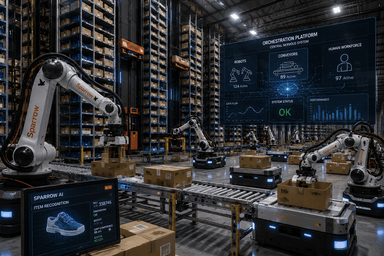
Robotic arms like Amazon’s Sparrow use AI to handle hundreds of millions of unique products. Shuttle systems run at high speed along rails inside the racking structures. They place and retrieve goods in seconds.
One software layer manages all physical components. This layer is called an orchestration platform. It acts as a central nervous system. It coordinates robots, conveyors, and any remaining human workers. By 2025-2026, these platforms became the backbone of modern logistics. They keep data and goods moving with few errors.
3. AMAZON VS. OCADO
Amazon’s Hybrid Model Amazon does not run pure dark warehouses. It uses a hybrid model. Robots handle repetitive tasks. Humans keep roles that need judgment and adaptability.
The results are clear. Since 2012, Amazon has put over one million machines into operation. Its Sequoia system stores inventory 75% faster. It cuts order processing time by one quarter. The AI model DeepFleet manages robot traffic and lifts movement efficiency by 10%. All of this comes together at the Shreveport, Louisiana facility. Robotics and AI cover every production zone there
Amazon still employs around 1.2 million people in its warehouses worldwide. Its most advanced sites need about 70% of the staff of a standard logistics center. That is a big reduction. But human labor has not been removed.
Ocado’s push for full automation
The British grocery logistics firm is the closest thing to a true dark warehouse in the industry. Ocado has built Customer Fulfilment Centers, or CFCs. Thousands of robots move across a giant grid called the Hive. They collect items from vertical containers.
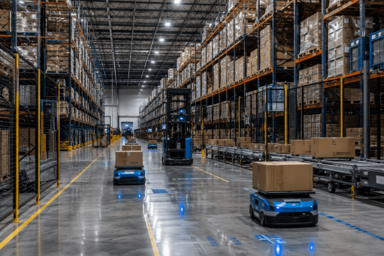
The company is working toward full independence from human labor. It invests heavily in AI and precision engineering
In financial year 2025, Ocado shipped 72 million orders worldwide. International volumes grew 26%. At its Erith site, 3,500 robots handle over 200,000 orders per week. The system produces 4 TB of data per day. Robots pick 50 items in under 5 minutes. The conveyor standard is over one hour. Food waste is 0.04%, against an industry average of 2-3%. Over 2,500 patents protect the technology
But the financial picture is troubling. Kroger shut three automated distribution centers in the US and paid $350 million in compensation. Building one CFC costs around GBP 150 million. Sobeys stopped its expansion in Canada. Critics say the model only works when order volumes are high and stable. That is not the case everywhere.
4. ROI ANALYSIS: WESTERN EUROPE VS. BULGARIA
Most European logistics firms are not tech giants. They run warehouses of 5,000 to 30,000 sq.m. They stock hundreds of thousands of SKUs. Capital is limited. The real question is not whether to automate fully. It is which investment makes financial sense and where.
Take a mid-size warehouse of 15,000 sq.m. It has 120 employees across three shifts and processes 8,000 orders per day. An investment of EUR 2.5 to 4 million covers mobile robots, automated racking, and management software. The payback timeline looks very different in the West versus Bulgaria.
- In Western Europe, wages for that team run around EUR 4.2 million per year. Automating 30 to 40 positions saves over EUR 1 million per year in wages alone. The investment pays back in about 3 years.
- In Bulgaria, the same team costs around EUR 1.93 million per year. The average employer cost per worker is about BGN 2,620, including social contributions. Automating the same positions saves around EUR 560,000 per year. The wage-driven payback stretches to 7 to 8 years
The takeaway is direct. In Western Europe, automation cuts costs by removing expensive headcount. In Bulgaria, the logic is different. The investment is not about cutting budgets. It is about beating a chronic labor shortage and enabling growth. Automation lets a warehouse handle 50% more orders without relying on staff that does not exist.
Base scenario 15000 square meter warehouse
| Parameter | Before Automation | After Automation (Western Europe) | After Automation (Bulgaria) |
| Warehouse area | 15 000 sq.m. | 15 000 sq.m. | 15 000 sq.m. |
| Headcount | 120 (3 shifts) | 80–90 | 80–90 |
| Annual labor cost | WE: ~EUR 4.2M / BG: ~EUR 1.93M | ≈. 3.0–3.2 million EUR | ≈ 1.37 million EUR |
| Orders per hour | Baseline | +50% | +50% |
| Pick errors | 1- 2% | Below 0,1% | Below 0,1% |
| CAPEX | — | EUR 2.5-4.0 M | EUR 2.5-4.0 M |
| Annual savings | — | Over EUR 1.0M | ≈ 560 000 EUR |
| Payback period | — | ≈ 3 years | ≈ 7-8 years (scale focus) |
Table 1. ROI Model for an Average European Logistics Center
5. THE FIVE PHASES TO A DARK WAREHOUSE
The shift to a dark warehouse does not happen overnight. The industry has mapped five phases that every company must go through.
Phase 1: Data collection. Before buying a single robot, gather detailed operational data. Track order volumes, routes, and time losses. Two to three years of clean data is the minimum. Without it, no solution can be designed well
Phase 2: Technology selection. Define which transport systems to use. Options include vertical lift modules, narrow-aisle systems, and other equipment. Map workflows in parallel. Show how goods move from receipt to dispatch
Phase 3: Physical infrastructure. Install conveyors, pallet depalletizers, and all connecting infrastructure between systems.
Phase 4: Integration and testing. Build a digital twin. This is a virtual model of the future warehouse. Run every possible scenario through it, including edge cases. Resolve every exception before it occurs in real life.
Phase 5: Full automation. Humans leave the operational zones. They stay at the inbound and outbound docks and in the control room. From there, they watch the system run on its own
6. RISKS AND LIMITATIONS
The risks of a dark warehouse are real. Do not underestimate them. Cost. Building a robotic distribution center like Ocado’s costs around GBP 150 million for core infrastructure alone. Covering an entire country costs over GBP 500 million. Very few operators can fund this.
Fragility. In a robotic environment, there is no human fallback. If order volumes drop below forecast, the financial model breaks. Costs are fixed. Revenue is not.
Lack of flexibility. A rival fulfilling orders from local stores may be faster and cheaper. A massive robotic center cannot quickly adapt when demand shifts.
Vendor lock-in. Ocado’s systems are proprietary. Clients cannot swap components or add tools from other vendors. As operators grow in automation maturity, this lock-in becomes a real problem
Cybersecurity. A connected, automated warehouse is a target for attack. One breach can shut the entire operation down. No physical access is needed.
7. SIX LESSONS FOR EUROPEAN OPERATORS
1. Orchestration matters more than hardware. Success depends on coordinating multiple systems into one workflow. The specific robot brand is secondary.
2. The hybrid model is more resilient. Amazon shows that combining robots with humans is more adaptable when volumes shift.
3. Data comes before robots. Without 2 to 3 years of clean operational data, automation cannot be designed well.
4. Automate the repetitive. Keep human judgment for edge cases and high-skill tasks. The best deployments automate transport and sorting. People handle the exceptions.
5. ROI is incremental. Partial deployment of mobile robots and automated racking gives measurable results within two to three years. A fully dark warehouse is a decade-long goal, not a budget cycle target
6. Flexibility beats density. In times of shifting consumer demand, the ability to adapt fast matters more than maximum storage density.
| Lesson | Practical Application | |
|---|---|---|
| 1 | Orchestration > hardware | Invest in a unified software layer before buying robots. |
| 2 | Hybrid models are more resilient | Combine AMRs with a human team for edge cases. |
| 3 | Data comes before robots | Require 2-3 years of clean operational data before deployment |
| 4 | Automate the repetitive | Leave judgment and exceptions to people. |
| 5 | ROI is incremental, not one-shot | Target 2-3 years payback with partial automation. |
| 6 | Flexibility beats density | Modular solutions beat maximum storage density. |
Table 2. Strategic Lessons for European Logistics Operators
CONCLUSION
The dark warehouse is not a myth, but neither is it an inevitable reality for most logistics operators. Technology exists, and Ocado, Amazon, and Chinese robotic factories prove it every day. However, the business case only works under specific conditions: high and predictable volume, limited product complexity, and sufficient capital for long-term investment.
For the average European operator, the path is gradual. Start with data. Move to partial automation. Then shift to a smart split between human and robotic work. Companies that invest in processes, not just machines, will be ready for whatever comes next.